What is Anticipatory Care Planning?
Anticipatory, sometimes known as advanced, care planning is a process involving patients, family, friends and healthcare professionals in discussions about the future. It aims to ensure that any treatment or care delivered is in line with a patient’s wishes. People who complete an ACP often feel a sense of control and more empowered that they are being listened to.
An Anticipatory Care Plan (ACP) is a dynamic record that should be developed over time; it should be reviewed and updated as the condition or the personal circumstances change.
In the context of palliative care, it is usually done when deteriorating health is anticipated. This often also encompasses a knowledge that a person’s life is limited and death is approaching, and should sensitively explore their understanding of prognosis, as well as an individual’s wishes and views about end of life care.
It is not legally binding, but is useful to start discussions to clarify treatment decisions, and also if a person loses capacity to make decisions can be used to guide health and social care professionals, along with those close to a person, in line with the Mental Capacity Act.
More information on ACP, including guidance for professionals in Scotland can be found on the national myACP website here.
Where is Anticipatory Care Planning recorded in Dumfries and Galloway? and Key Information Summaries
The electronic key information summary (eKIS) is the main place to look for ACP discussions. GP practices are the only places that can contribute to an eKIS, but it can be seen by a wide range of health professionals, including the ambulance service. If you have had an ACP discussion the be sure to involve the GP so that they know what is happening with their patient, and they can accurately update the eKIS. In secondary care, the eKIS can be found if you click on the ECS tab – it will appear as another tab once this has been done.
A guide has been created to help GPs completing a KIS, and it can be found here.
There is also a “Patient preferences” specialty within Clinical Portal, where Treatment escalation plans (TEPs), DNACPR forms and ACP summary documents are scanned.
Patients may also have hard paper copies that they keep myACP, or may have filled in the myACP app.
We are also beginning to implement the ReSPECT process. More information about ReSPECT can be found here.
Who is it for?
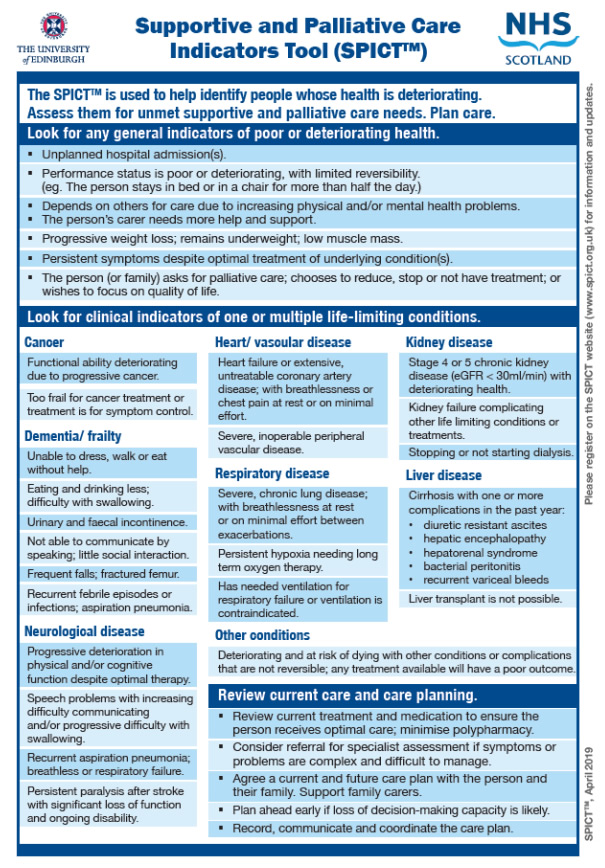
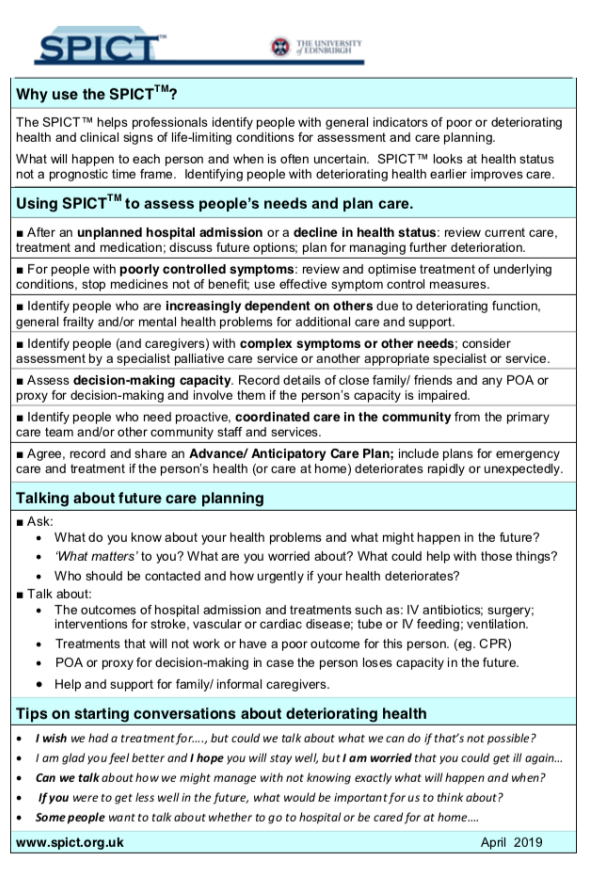
Creating an ACP is something that we can all do. However, it is particularly helpful where health or care needs are particularly complex, where there is an anticipated decline in someone’s health, or where someone has a life limiting illness. Tools such as SPICT (see example below) or frailty scores can help identify people at risk of deteriorating health, and who should therefore be given the opportunity to develop an ACP. SPICT-4ALL has been developed for use by staff working in care homes, care at home providers, families, or others who may not have the medical information needed to complete a SPICT.
Not everyone wants to complete an ACP or talk about the future, and this should be respected. However, ACP is not about limiting treatment options: it is about helping someone understand the condition that they are living with, helping them understand predictable consequences of that, documenting their wishes should their health or circumstances change, and ensuring that health and social care staff act in accordance with these wishes, as far as is practical.
What should be included?
Start with who would the person want to be involved in decision making? e.g. family, NOK, friends
- What is their understanding of their illness?
- Given this understanding, what is important to them (holistic – includes social aspects not just medical treatments)
- Caring responsibilities / any plans for if they become unwell.
- Religious and spiritual beliefs
- Dietary requirements
- Treatments they would or wouldn’t want.
- Views on cardiopulmonary resuscitation (CPR)
- Preferred place of care and death
- Organ donation
How can I start an ACP discussion?
It is important that every health and social care professionals who works with people with complex or life limiting conditions has an understanding of what an ACP is and when it is appropriate to introduce the topic.
REDMAP (see box below) is a helpful framework to use, developed by EC4H. More information is available from the EC4H website here.
A guide has been created to help GPs completing a KIS, and it can be found here.
ACP discussions ideally are done when there is not a rush. It may be helpful to offer the myACP booklet for people to work through with their friends and family and then review at a later date.
If situations are more complex, or you feel unable to answer the person’s questions, then seek help within your own team, or ask the Specialist Palliative Care team for advice.
| Talking about Anticipartory Care Planning: RED - MAP | |
|---|---|
|
R eady |
Can we talk about your health and care? |
|
E xpect |
What do you know / want to ask / expect? |
|
D iagnosis |
We know... / We don't know... Questions? |
|
M atters |
What matters to you now? |
|
A ctions |
What can help.../ This will not work... |
|
P lan |
Let's plan ahead for when / if... |
Resources to develop communication skills in relation to ACP discussions
Video from the Royal College of Physicians and Surgeons of Glasgow (6 mins long) – Dr Kirsty Boyd (Palliative Medicine Consultant) explains how to use REDMAP
Effective communication for healthcare (EC4H) have also got a useful section on ACP discussions found here.
A website from North America which has useful videos on communication and palliative care including ACP – VITAL TALK